.png)
Hint: It isn't some fancy new tracking tool.
Our most recent customer survey indicated that customers want more tracking visibility, yet few are diving into the details of tracking among their carrier network. About 70% of respondents do not look at the number of tracking updates or pings, and just over 80% don't look at the source of tracking (mobile device, TMS, v. GPS or ELD). Still, tracking compliance is commonly used to score carrier performance.
So, why aren't shippers doing a deep dive into tracking? We have some ideas.
- Technical Complexity: There's a lot of technical work needed upfront to set up various tracking platforms. API connections can assist, but the technical nature can still deter or delay updates. In short, not every carrier has the tech expertise, leading to a lack of comprehensive data.
- Information Overload: Once the connections are set up and working, there's a wealth of information to sift through. The more tracking "pings," the better the data but also the more robust and time-consuming it becomes to analyze.
- Fragmented Networks: One shipment could involve multiple carriers, especially in fragmented supply chains that use different modes and platforms. This creates data gaps and makes comprehensive tracking challenging by creating blind spots.
- Imperfect Analytics: Companies in the tracking software space are tackling these issues with analytics and metrics. However, the accuracy is often compromised due to the technical setup and variety of carriers and transport modes involved.
Don't jump the gun and spring for a costly solution before reading through these solutions. We asked our driver team how to improve tracking visibility to provide you with driver insight.
.png?width=1600&height=900&name=HS%20Email%20or%20Blog%20Content%20Box%20(7).png)
This data might be confusing since about 30% of the drivers who responded to our survey want more options for communicating tracking updates, and that might help you justify that big spend on new tech. The truth is the solution does not lie in tech alone. It lies with drivers.
- Add more options for communicating tracking updates: This is where tech can come in to help, but keep in mind it can hurt as well. It's about finding the right tech and knowing how to use it.
- Drivers or carrier enter in their own times: This might cause some issues for obvious reasons. Carriers and drivers don't want to tell on themselves if they are late, so this would require checks and balances. This might cause more work than it's worth.
- Provide an incentive program for proper tracking: This is something that can be done at both the shipper and carrier level. You can reward drivers and carriers that provide quality tracking on a consistent basis.
- Provide training for tracking software: This is an important one. New tech is great. It's even better when it's set up properly and working. It does nothing for you if #1 it's not being used, or #2 it's not being used correctly. Training can solve that problem.
- Adding a minimum # of updates based upon transit time: This one can get a bit complex, hence it coming in at the bottom.
The 14% of other responses provided some solid advice for everyone, pointing out that the number you are calling from matters. If you call from an 800 number, drivers might not answer because they think it's a scam. One of our drivers pointed out that some of the big brokers in the industry are guilty of this. Can you blame drivers for being skeptical?
Looking at the suggestions from our driver team, we asked our Linkedin audience to weigh in on a few options.
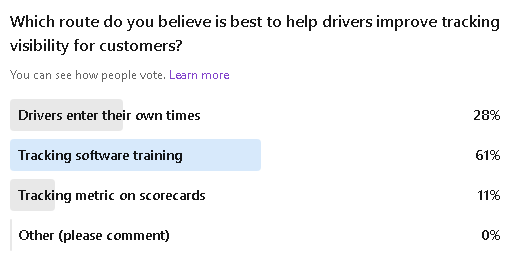
The biggest takeaway is that training trumps giving drivers the capability to enter in their own times. Skepticism lives on both sides of a shipment, so what's the solution?
- Get to know your network: When's the last time you reviewed your network? How well do you know your providers? It's a lot easier to collaborate across all aspects of your supply chain if you stay connected. Treat them like partners and find ways to integrate. Again, everyone benefits from improved visibility across the supply chain.
- Find the right tech: Maybe your providers and business partners can help point you in the right direction. You want to find something that will last and can easily integrate to not only the systems you use but the systems your network uses.
- Spend time onboarding: Timing is everything.
- Do your research for technology and find out just how support and extensive their onboarding is. They should give you as much time as you need, so if they don't ask you about your calendar, your business, and your plans for the rest of the year, they are going off of their own schedule.
- On the flip side, be realistic about your onboarding timeline. Too much change and too soon can wreak havoc on visibility.
- Give yourself an overlap or backup plan. Don't give up your previous tracking software until the new one is up and running, so you can avoid being in the dark.
- Training, training, and more training: It's part of onboarding when you bring in new software, but it also needs to be included across all aspects of your business. Shippers can include it when onboarding new providers and providers can include it for drivers and carriers. Offering continued training for these and refresher courses can increase tracking visibility and quality.
- Ask your tracking platform to help you succeed. Many have seen this gap in knowledge and added roles specific to customer success. They provide classes and will work around your schedule. Good software will keep options like this going, not just to get your foot in the door.
- It's not just about training for operating the software or navigating the tracking platform. It's about analytics. Be sure to include analytics in the training so everyone understands how tracking is performing.
Tracking visibility in the supply chain faces numerous challenges, from technical complexities to human factors. Go beyond mere tracking capabilities to achieve true visibility, benefiting all stakeholders in the supply chain. At AMX, we understand that improving this visibility starts with better understanding your own network. To address this, we offer a unique, free quiz designed to help you identify if the "Top 5 Mistakes Shippers Make in Their Network" is hindering tracking visibility. Beyond this diagnostic tool, we provide our scoring guide and free consultation with our team.
🎁 Our 35 years of experience is at your fingertips with our free quiz.